Beverly Eckert
The 9/11 widow who publicly refused the government's compensation money — "my silence cannot be bought" — sued for sworn testimony instead, helped force the 9/11 Commission into existence, and died in a plane crash six days after meeting President Obama.
| Field | Details |
|---|---|
| Full Name | Beverly Eckert |
| Born | May 29, 1951, Buffalo, New York |
| Died | February 12, 2009, Clarence Center, New York (age 57) — Continental Connection Flight 3407 |
| Role | 9/11 Family Member / Advocate — member, 9/11 Family Steering Committee; co-chair, Voices of September 11th |
| Husband | Sean P. Rooney (1951–2001), VP of risk management at Aon Corporation, 98th floor, WTC South Tower |
| Residence | Stamford, Connecticut |
| Education | Buffalo State College, fine arts, 1975 |
| Platform | Family Steering Committee, Voices of September 11th, congressional advocacy, op-eds, litigation |
| Notable Work | "My silence cannot be bought," USA Today, December 19, 2003 |
| Status | DECEASED (2009) |
| Key Claim | The Victim Compensation Fund was structured to buy off litigation and thereby prevent the sworn testimony and discovery that would expose why the attacks were not stopped |
| Evidence Rating (advocacy record) | WELL-DOCUMENTED |
| Evidence Rating (suspicious-death claim) | SPECULATIVE |
Image Evidence
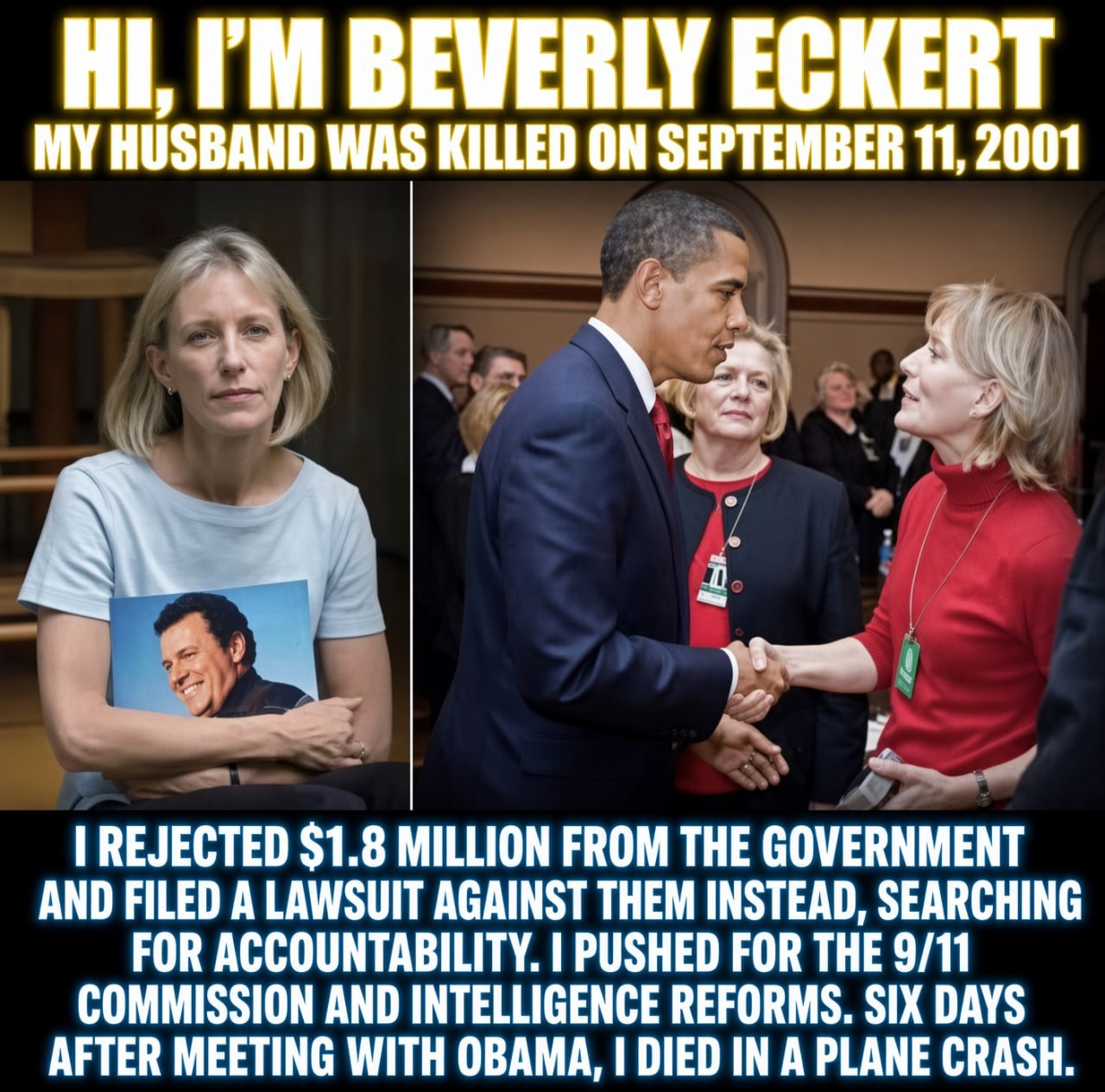
Circulating memorial graphic summarizing Eckert's record: rejecting the compensation fund, suing for accountability, pushing for the 9/11 Commission and intelligence reform, and dying in a plane crash six days after meeting President Obama. The right-hand photograph is from the February 6, 2009 White House meeting. Source: @911Revisionist on X, August 16, 2026.
Who She Was
Beverly Eckert met Sean Rooney at a Canisius High School dance when both were 16. They married in 1980 and lived in Stamford, Connecticut. On the morning of September 11, 2001, Rooney was working on the 98th floor of the South Tower as vice president of risk management for Aon Corporation. He and Eckert spoke and exchanged messages while he was trapped. He climbed toward the roof, reached the 105th floor, and could not get out. The tower collapsed while they were on the phone.
Eckert did not become a public figure by choice. She became one because she decided that the way the attacks were investigated — and the way the families were compensated — was itself a problem that had to be fought.
Rejecting the Victim Compensation Fund
The September 11th Victim Compensation Fund offered families federal payments in exchange for waiving the right to sue US persons, corporations, or government entities. Roughly 97% of eligible families took the money. Approximately 95 families did not. Eckert was one of them, and she was the one who explained the decision in public.
On December 19, 2003 — as the filing deadline closed — she published a statement in USA Today under the title "My silence cannot be bought." Her argument was procedural, not emotional: a lawsuit compels sworn testimony and can force the production of evidence, and neither the congressional hearings nor the 9/11 Commission had that power.
The $1.8 million figure that circulates in memes comes from Eckert's own op-ed, and the precise wording matters: she wrote that by suing she had forfeited "the '$1.8 million average award' for a death claim I could have collected under the fund." That is the fund's average death-claim award, which she gave up — not a specific sum offered to her personally to stay quiet. Nothing in the documentary record establishes that anyone offered Eckert money in exchange for silence. What the record does establish is that she publicly characterized the fund's structure as a mechanism for buying off accountability, and refused it on that basis.
She was explicit that she did not expect to win money:
"Nor do I have any illusions about winning money in my suit. What I do know is I owe it to my husband, whose death I believe could have been avoided, to see that all of those responsible are held accountable." — Beverly Eckert, USA Today, December 19, 2003
Reporting available in the public record does not establish whether her 9/11 wrongful-death litigation had been resolved at the time of her death.
Forcing the 9/11 Commission Into Existence
Eckert sat on the 9/11 Family Steering Committee and co-chaired Voices of September 11th, one of the organizations in the Coalition for an Independent 9/11 Commission alongside Families of September 11 and September 11th Advocates — the group better known as the "Jersey Girls."
The Bush administration initially opposed an independent commission. The families forced it. The Family Steering Committee then supplied the Commission with question lists, publicly tracked which questions went unanswered, and objected on the record to the Commission's structure — including the appointment of Philip Zelikow as executive director, given his prior work with the incoming Bush administration. Eckert also pushed for the intelligence-reform legislation that followed the Commission's report, and separately raised skyscraper egress and survivability questions about the Port Authority's construction standards — a direct consequence of her husband dying on a floor he could not escape from.
According to 911Truth.org, she also joined September Eleventh Families for Peaceful Tomorrows, the family organization that opposed military retaliation for the attacks.
That combination is the reason she matters to this investigation. She was not an outside critic. She was a family member with standing whom the government had to deal with, who used that standing to demand testimony under oath, and who kept score in public on what was never answered.
Key Quotes
"I've chosen to go to court rather than accept a payoff from the 9/11 victims compensation fund. Instead, I want to know what went so wrong with our intelligence and security systems that a band of religious fanatics was able to turn four U.S. passenger jets into an enemy force, attack our cities and kill 3,000 civilians with terrifying ease. I want to know why two 110-story skyscrapers collapsed in less than two hours and why escape and rescue options were so limited." — Beverly Eckert, "My silence cannot be bought," USA Today, December 19, 2003
"So I say to Congress, big business and everyone who conspired to divert attention from government and private-sector failures: My husband's life was priceless, and I will not let his death be meaningless. My silence cannot be bought." — Beverly Eckert, USA Today, December 19, 2003
"I am suing because unlike other investigative avenues, including congressional hearings and the 9/11 commission, my lawsuit requires all testimony be given under oath and fully uses powers to compel evidence." — Beverly Eckert, on why litigation rather than the Commission
The February 6, 2009 White House Meeting
Six days before she died, Eckert was at the White House. On February 6, 2009, President Barack Obama met with family members of 9/11 victims and of the victims of the USS Cole bombing to discuss his administration's handling of terror suspects — the suspension of the Guantanamo military commissions and the planned closure of the detention facility, ordered by executive action in his first week in office. The photograph of Obama shaking Eckert's hand at that meeting is the right-hand panel of the graphic above.
Obama publicly acknowledged her death the following week, describing her as a tireless advocate for the families and noting he had met with her only days earlier.
Death: Continental Connection Flight 3407
On February 12, 2009, Eckert boarded Continental Connection Flight 3407 — a Bombardier Dash 8 Q400 operated by Colgan Air — from Newark to Buffalo. She was traveling to Buffalo for what would have been Sean Rooney's 58th birthday and to present a scholarship established in his name at Canisius High School, his and her shared connection to the city she was born in.
On approach to Buffalo Niagara International Airport, the aircraft entered an aerodynamic stall and crashed into a house in Clarence Center, New York. All 49 people aboard and one person on the ground were killed.
In June 2009, her executor and sister Margot Eckert filed suit against Colgan Air, Pinnacle Airlines, and Continental Airlines. Her sister Karen Eckert became one of the "Families of Continental Flight 3407" advocates whose campaign produced the Airline Safety and Federal Aviation Administration Extension Act of 2010 — the law behind the 1,500-hour rule for airline first officers and reformed pilot fatigue standards. Two of Eckert's causes therefore outlived her: the intelligence reforms after 9/11, and the aviation-safety reforms after the crash that killed her.
What the Official Investigation Found
The National Transportation Safety Board investigated and adopted its final report (NTSB/AAR-10/01) in February 2010. The Board's determination:
The probable cause of this accident was the captain's inappropriate response to the activation of the stick shaker, which led to an aerodynamic stall from which the airplane did not recover.
Contributing factors identified by the NTSB:
- The flight crew's failure to monitor airspeed in relation to the rising position of the low-speed cue
- The flight crew's failure to adhere to sterile cockpit procedures
- The captain's failure to effectively manage the flight
- Colgan Air's inadequate procedures for airspeed selection and management during approaches in icing conditions
The stick shaker fired while the aircraft was still meaningfully above stall speed; the captain pulled aft on the control column rather than pushing forward, which is the opposite of stall recovery. The Board found the crew's training and the carrier's procedures, not the icing itself, to be the operative failures. Investigators also documented commuting and rest issues for both pilots — findings that drove the 2010 legislation.
The Suspicious-Death Claim
The graphic above compresses Eckert's story into a sequence — she refused the money, she sued, she pushed for the Commission, she met Obama, she died six days later — and the sequence is factually accurate. A section of 9/11 research treats that sequence as evidence that her death was not an accident.
Stating the case honestly requires separating the two halves:
What is documented: Every element of the timeline is verifiable. Eckert did publicly refuse the fund and say so in print. She did litigate specifically to compel sworn testimony. She was a leading force behind the Commission's creation and a public critic of how it was run. She did meet the President on February 6, 2009. She did die on February 12, 2009.
What is not documented: There is no evidence in the NTSB investigation, the litigation, or any subsequent inquiry that Flight 3407 was brought down deliberately or that Eckert was targeted. The aircraft carried 48 other passengers and crew whose deaths would have to be collateral to any such theory. The NTSB's probable cause is a specific, mechanically coherent pilot-input failure that the flight data recorder captured directly, and it produced federal legislation on that basis. Claims that Eckert was killed to silence her circulate widely online; this investigation has found no primary evidence supporting them, and rates the claim SPECULATIVE.
The stronger and better-supported point is the one Eckert made herself while alive: that the compensation fund was designed to close off the discovery process, that the Commission lacked the power to compel what a court could compel, and that the questions the Family Steering Committee filed were never answered. That argument does not depend on how she died. It rests on documents she signed her name to.
Key Arguments & Evidence She Cited
- The fund's waiver structure: Accepting payment required surrendering the right to sue any US person, corporation, or government entity — the only mechanism with subpoena power available to families
- Sworn testimony vs. voluntary cooperation: Neither the congressional hearings nor the 9/11 Commission could compel testimony under oath from every relevant party; a civil suit could
- The unanswered Family Steering Committee questions: The Committee published question lists and publicly tracked which were never addressed in the final report
- Building survivability: Why escape and rescue options from the upper floors were so limited, and what the Port Authority's construction standards permitted
- Intelligence and security failures: Why the security system permitted four aircraft to be turned into weapons "with terrifying ease"
Where She Said It
- USA Today, December 19, 2003 — "My silence cannot be bought," the statement that defined her public position
- 9/11 Family Steering Committee statements and question lists, 2003–2004
- Voices of September 11th advocacy and congressional testimony on intelligence reform
- The White House, February 6, 2009 — meeting with President Obama and 9/11 / USS Cole families
- 9/11: Press for Truth (2006) and related coverage of the families' campaign for an independent investigation
Related Perspectives
- 9/11 Commission — The body Eckert and the Family Steering Committee forced into existence, then publicly criticized for its budget, its structure, and its omissions
- Philip Zelikow — Executive director of the Commission; the Family Steering Committee objected on the record to his appointment given his prior work with the Bush transition
- Bob Graham — Co-chair of the Joint Inquiry, who spent 14 years fighting to declassify the 28 pages on Saudi connections; the same fight over what families were permitted to know
- Twin Towers WTC — The collapse Eckert demanded an explanation for, and the building her husband could not escape
Other Coverage Worth Reading
- Sibel Edmonds: FBI translator gagged twice under State Secrets after finding the Bureau had pre-9/11 warnings it buried.
- William Rodriguez: Last man pulled alive from the North Tower says explosions hit the basement before the plane did.
- Susan Lindauer: CIA asset who says she delivered advance warnings, then was arrested under the Patriot Act.
- Building Seven WTC7: The 47-story tower no plane hit, which fell at freefall and went unexplained by the Commission.
X.com posts:
Sources
- Beverly Eckert — Wikipedia
- Woman Rejects Sept. 11 Fund, Sues for Accountability — NPR — contemporaneous reporting on her decision to litigate
- Beverly Eckert — 911Truth.Org — her advocacy record, the USA Today statement, and her litigation strategy
- 9/11 Widow Among Buffalo Flight Victims — CNN
- Beverly Eckert, Sept. 11 Widow, Died in Fiery Buffalo Flight 3407 Crash — ABC News
- 9/11 Widow Among Victims of Crash Near Buffalo — NBC News
- Loss of Control on Approach, Colgan Air Inc., Flight 3407 (NTSB/AAR-10/01) — the official probable-cause determination
- NTSB Accident Investigation DCA09MA027 — investigation docket
- September 11th Victim Compensation Fund — Wikipedia — the waiver structure and participation rates
- Suit Filed in Airline Death of 9/11 Spokesperson — Courthouse News Service — the June 2009 suit filed by her estate
- Family Steering Committee member Beverly Eckert — Unanswered Questions
This information was compiled by Claude AI research.