Jack Ruby
| Field | Detail |
|---|---|
| Real Name | Jacob Leon Rubenstein |
| Born | March 25, 1911, Chicago, Illinois |
| Died | January 3, 1967, Dallas, Texas (lung cancer, while in custody) |
| Role | Shot and killed Lee Harvey Oswald on live television, November 24, 1963 |
| Occupation | Owner of Carousel Club (strip club), Dallas; organized crime connections |
| Evidence Rating | STRONG — Ruby's mob connections are documented; his motive for killing Oswald is disputed |
Status: Deceased (1967)
Overview
Jack Ruby shot Lee Harvey Oswald at point-blank range in the basement of Dallas Police Headquarters on November 24, 1963 — two days after Kennedy's assassination — in front of television cameras broadcasting live to the nation. This act prevented Oswald from ever standing trial and answering questions under oath about the assassination.
Ruby was tried, convicted of murder, and sentenced to death. His conviction was overturned on appeal. While awaiting a new trial, he died in custody of lung cancer in January 1967.
The Warren Commission concluded Ruby acted alone out of grief over Kennedy's death and a desire to spare Jacqueline Kennedy from testifying at a trial. Most researchers consider this conclusion implausible given Ruby's background and connections.
Organized Crime Connections
Ruby's connections to organized crime are extensively documented:
- Ruby was born Jacob Rubenstein in Chicago and had documented connections to Chicago mob figures from a young age.
- In the 1940s and 1950s, Ruby was involved in illegal gambling operations in Dallas and had documented contacts with mob figures including Carlos Marcello (New Orleans) and Santos Trafficante (Florida/Cuba).
- Ruby made telephone calls to known organized crime figures in the weeks before the assassination, according to phone records obtained by the HSCA.
- The HSCA found that Ruby's pattern of phone calls in October-November 1963 was "unusual" and consistent with coordinating with organized crime figures.
- Ruby had Dallas police contacts and was known to socialize with Dallas PD officers — explaining how he gained access to the police basement.
Ruby's Own Statements
Ruby asked to be taken to Washington to speak to the Warren Commission, stating he feared for his life in Dallas. He was denied. He told Chief Justice Warren:
"I want to tell the truth, and I can't tell it here... If you put me in Washington, I could tell you the truth."
In other statements Ruby indicated that the "real story" would never come out, and that powerful forces were involved in the assassination. His statements were disjointed and he was reportedly medicated during his testimony.
Ruby died in January 1967. He told reporters he was injected with cancer cells to kill him.
Motive: Kunstler's Account
In his memoir My Life as a Radical Lawyer, civil rights attorney William M. Kunstler recounts conversations he had with Ruby in which Ruby allegedly stated his motive for killing Oswald was to protect American Jews from a backlash. According to Kunstler:
"When Jack told me he had killed Oswald 'for the Jews,' I believed him. On each of the three occasions we talked, he said, 'Bill, I did this so they wouldn't implicate Jews.' Lee Harvey Oswald had belonged to Fair Play for Cuba, an organization with a number of Jewish members. Because of this association of Oswald's, Jack's convoluted thinking led him to believe that the Kennedy assassination would be linked to Jews. [...] He wanted to protect American Jews from a pogrom that could occur because of anger over the assassination."
Kunstler also reports Ruby saying: "I wanted to save Mrs. Kennedy from being put through the ordeal of a trial, and that's why I did this thing."
Ruby (born Jacob Leon Rubenstein) was Jewish, and his stated concern about Oswald's membership in the Fair Play for Cuba Committee — which had Jewish members — being used to scapegoat American Jews is the version of motive Kunstler attributes to him. This account is independent of the Warren Commission's stated rationale (grief and a desire to spare Mrs. Kennedy testifying), though the second quote echoes the Commission's framing.
Researchers treat Kunstler's account with caution: Ruby's statements were often disjointed, he reported being medicated, and he gave multiple inconsistent explanations across his remaining years. The Kunstler quotes are presented here as reported by Kunstler in his own published memoir.
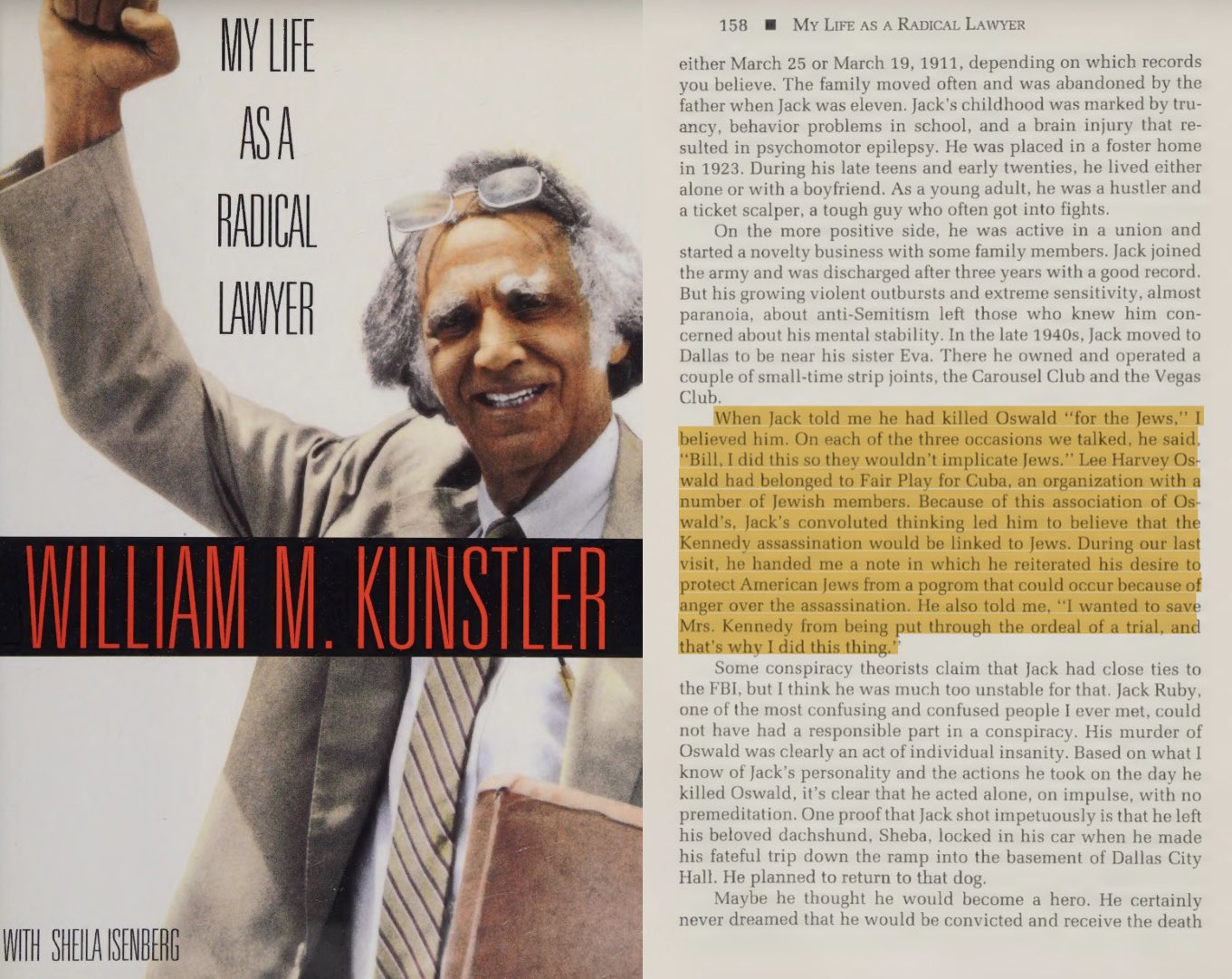
Excerpt from William M. Kunstler's My Life as a Radical Lawyer recounting Ruby's stated motive. Source: @Pepe733745533 on X, 2026-05-15.
Access to the Police Basement
How Ruby gained access to a supposedly secured police basement holding the most important prisoner in American history has never been satisfactorily explained. Theories include:
- Help from Dallas police contacts (Ruby knew many officers)
- A deliberate security stand-down
- Ruby was allowed in by someone who knew Oswald needed to be silenced
Counterarguments
- Ruby claimed he acted spontaneously out of anger and grief.
- The Warren Commission accepted this version.
- Ruby had no known direct operational connection to the CIA or foreign intelligence.
Related Pages
Sources
- House Select Committee on Assassinations, Volume IX (1979) — Ruby chapter
- Seth Kantor, Who Was Jack Ruby? (1978)
- Warren Commission testimony of Jack Ruby (June 1964)
- William M. Kunstler, My Life as a Radical Lawyer (1994) — Kunstler's recounted conversations with Ruby
X.com posts:
Last Updated: 2026-05-15 — Added Kunstler motive account (Ruby's stated reason for killing Oswald, per My Life as a Radical Lawyer)